The operating system for Audit-Ready Care.
The note. The order. The proof. Ready before the next patient.
Patientflows connects clinical documentation, product selection, orders, communication and audit defense in one workflow. Built for outpatient wound centers and mobile wound care — and for the podiatry, vascular, plastic and dermatology practices carrying real wound volume.
No card required · See a live walkthrough · Founder pricing while spots last
Documentation stopped being paperwork. It became defense.
EMRs document visits. Vendor portals show their own orders. No one built the layer in between — so the friction, the risk, and the leaked revenue all live in the gap. Every role in your practice pays for it.
-
A different login for every job
One wound program we work with was running six systems to see a single patient. Every one is another login, another silo, another place a dollar quietly leaks — and someone burning four hours a day just turning faxes into referrals by hand.
-
The note waits — and so does the filing
Four or five clicks to do one thing, so the note sits — for after hours, the weekend, when the detail’s already fuzzy. Then billing spends the week hounding providers to close charts before the timely-filing clock runs out. The record that has to defend you gets built late, by whoever’s most tired.
-
Every chart could be a deposition
Authorizations expire silently. A staffer chases red-flagged quality measures by hand every quarter. Then the letter arrives, and two weeks of somebody’s job becomes reconstructing a chart from five systems. One program lived a six-figure clawback before they fixed it.
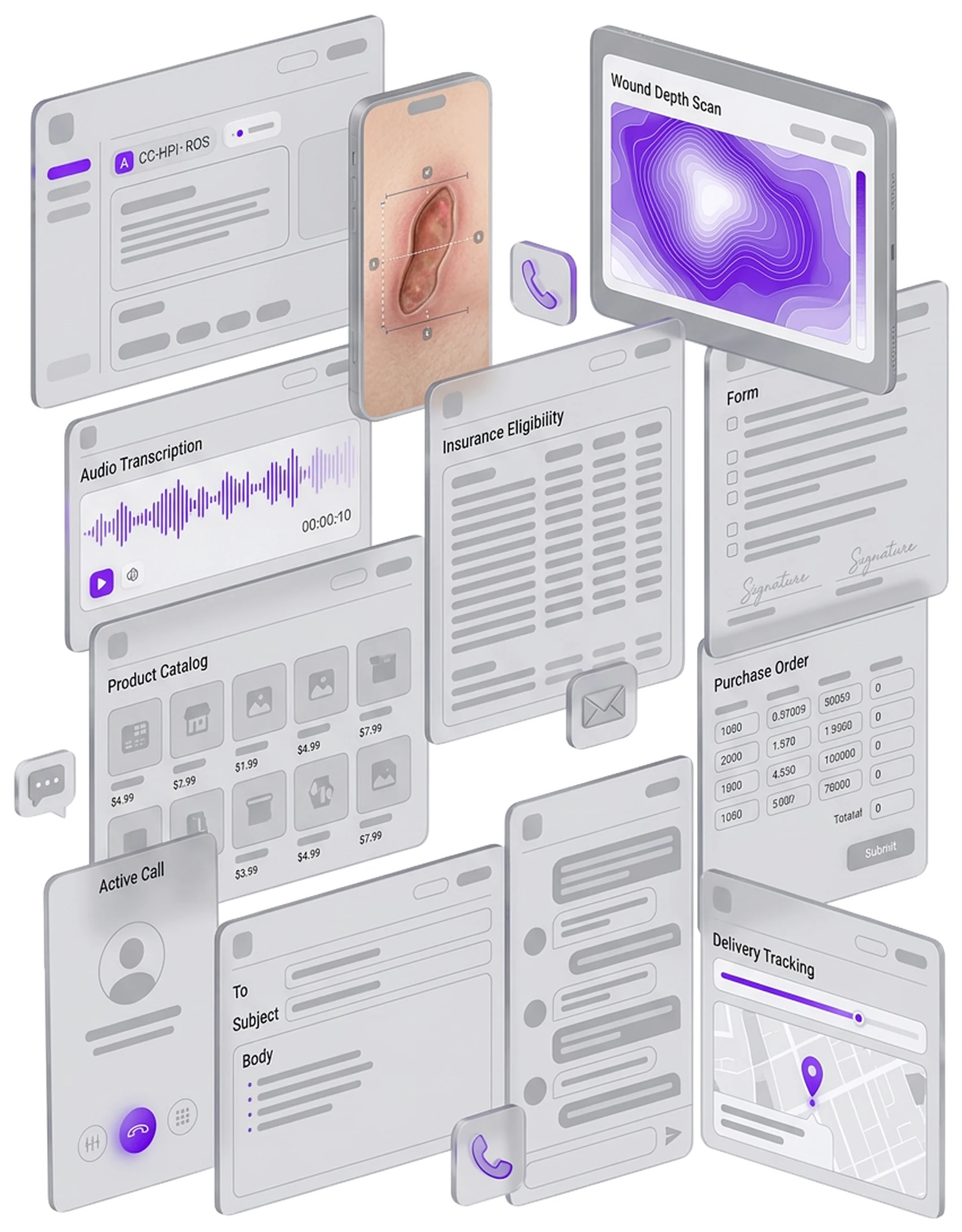
You did everything right.
The note just couldn’t prove it.
The difference isn't the features.
It's what they're built on.
Every EMR is a database. It's in the name — electronic medical records. A database is a shelf: it holds what you put on it and waits to be asked. Patientflows was built on a workflow engine instead, so the system runs the work rather than storing proof that you did.
A shelf can't run a clinic. A database holds what you put on it and returns it when asked. No conditional logic, no rules that fire, no step that knows what the next one needs. So every capability above it has to be added later and driven by a human.
Workflows can act. Shelves can't. Conditional logic means the system responds to what it finds. Rules fire, steps connect to other steps, and because that logic already exists, AI has something to be agentic about. We didn't set out to build an EMR. We built the engine that runs a wound practice, and the record fell out of it.
Three questions to ask any wound-care platform.
Does it have conditional logic, or does it only store what you type?
Workflow‑first. If‑then, rules that fire, and steps that know what the next one needs. The system acts on what it finds instead of waiting to be asked.
Is the AI actually agentic, or is it search bolted onto a shelf?
Agentic by construction. Sherpa acts on logic that already exists in the workflow. Bolt AI onto a database and the only thing it can do is find text faster.
Can you show me the system doing something nobody asked it to do?
Yes — live, on your cases. The coverage gap surfaces before you submit. The ADR response drafts from the ARC File. Not because someone clicked. Because a rule fired.
Patientflows answers yes to all three — and will show you the third. Ask every other platform the same three questions.
Everyone aligned. In real time.
Clinicians, billers, vendors, and patients — four interfaces, one shared record. No re-keying, no portal-hopping, no version only one team can see.
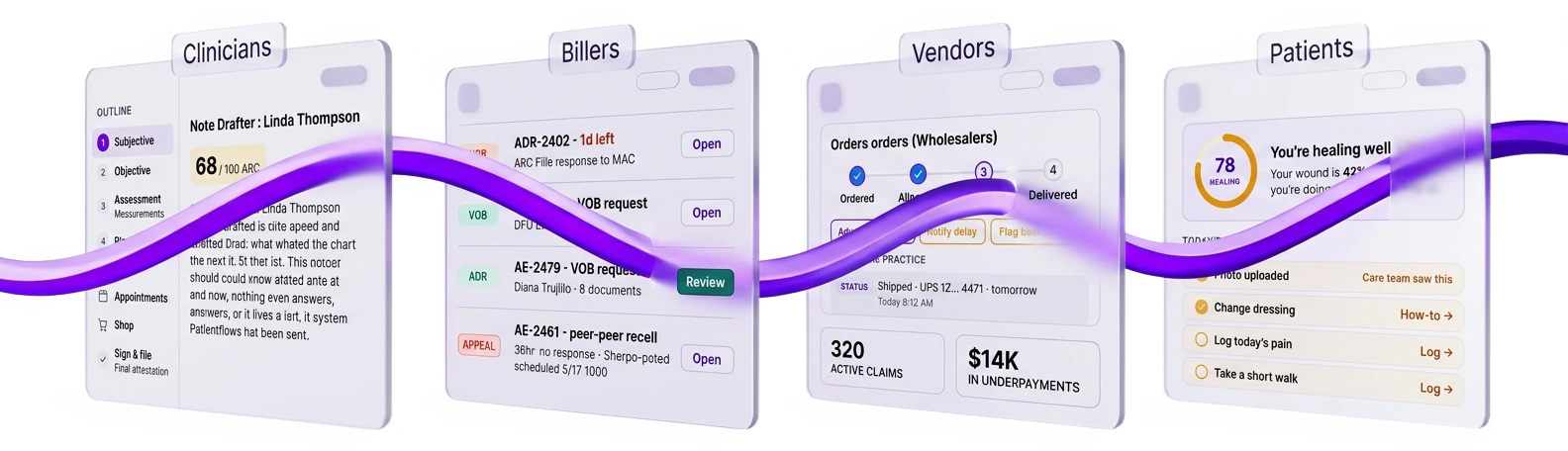
Nothing re-keyed. The order the clinician places is the order the biller works, the vendor fulfils, and the payer sees.
Nothing hidden. The vendor sees fulfilment, the patient sees their care, and nobody waits on a portal invitation.
Nothing waiting. Everyone acts on the same record at the same moment, so the handoff stops being a delay.
It starts with the visit. It ends with your proof.
One current runs the whole way: the visit becomes the note, the note becomes the order, the order becomes the claim, and the claim becomes your defense. Nothing re-keyed. Nothing lost in a gap.
Scheduling & Routing
The visit lands on the schedule — and if it's a field visit, the route optimizes itself.
Ambient Scribe
Scribe listens and transcribes the encounter as it happens. Hands-free, in the room.
Dr. Patel Wound on the left hallux measures three point zero by two point two centimetres, depth superficial.
Linda Every time I leave the bedroom, yes. My daughter checks.
Dr. Patel Wound bed eighty percent granulation, twenty percent slough, no eschar.+2
Note Drafter
The transcript becomes a structured, signature-ready note. You review it — you don't retype it.
Order Builder
The order builds straight from the note, scored against the LCD and gated before it can go out wrong.
Verification
Coverage and eligibility are verified up front. The liability check happens before fulfillment — not after the denial.
Fulfillment
The product ships — timestamped and tracked, with lot and serial captured to the record.
Billing
A clean claim goes out. The biller works the exact order the clinician placed — nothing re-keyed.
Defensibility
The ARC File is already assembled. When an ADR arrives, it's a download — not a fire drill.
That is one patient, end to end. Run your own and see where the gaps are.
Sherpa works the list. You work the patient.
Every action starts from one New Task button. Sherpa proposes, you confirm and attest. Its authority escalates as your practice matures. Yours never moves.
Reads what you upload
Sherpa parses documentation, asks for what's missing, structures the order, and runs LCD pre-flight. This is the floor. Every level above includes everything below it.
Suggests and approves
Full chart context. Sherpa proposes at every decision — documentation gaps, order assembly, referral triage — and you attest. You are the author; Sherpa is the assistant.
Drafts routine work
Sherpa drafts outreach, denial responses, appeal starts, recall messaging and care-coordination tasks. You review and send. Your team stops doing what a machine can do.
Executes with gates
Routine work happens autonomously. Money and compliance actions hold for your attestation. Enterprise adds custom thresholds, tuned with a named Patientflows engineer.
Two minutes. Then decide if it's worth a call.
“Why did you choose this product?”
It's the question in front of an administrative law judge. The honest answer can't be “my rep told me to.” With Patientflows you open one file: the wound, the failed conservative care, the payer policy, the clinical evidence, the medical necessity. Indexed and legible.
Sources: 42 CFR § 405.903 (response window) · 42 CFR § 405.1028 (good cause for new evidence) · SSA § 1893(f)(3) (extrapolation).
Readiness turns the whole thing from a fire drill into a download.
Graded before you submit
Every note and order gets an ARC Score — a gap analysis against the LCD, payer policy, and documentation integrity. Amber? Draft the addendum right there, attest, and the score moves to green before the claim goes out.
Assembled from day one
When the ADR letter arrives, you don't hunt across the EMR, the portal, the fax, and a drafts folder. Open the ARC File, pick the scenario — ADR, Level 1, Level 2, ALJ — and export.
The standard never changes. What escalates is what happens when the audit gets real.
Everything else that runs a wound practice.
The continuum covers the clinical work. This is the rest of the operation — bundled, on the same record, in every tier.
Keep your EMR. Ours is included anyway.
Patientflows is EMR-agnostic. Run it alongside the system you already have, or run ours — the operating record is bundled in every tier, never a bolt-on and never a line item. You get to use it before you decide anything. If it turns out to be the better place to work, consolidating is your call, not a condition of starting.
The front office, included.
CRM, phone, text, e‑fax, chat and scheduling on the same record as the chart. Referrals stop living in a fax tray.
One catalog, agnostic by evidence.
Every product in one place, organised by what the record supports — not by who happens to be calling on you this week.
The patient stays in the loop.
Photos, dressing changes, pain logs and care-plan steps from the patient's phone, landing in the record your team already works from.
Your data, never held hostage.
Standard formats, exportable during your subscription and for 90 days after you leave. In writing.
The community that replaces the rep.
A merit-based network of wound clinicians: protocols, product evidence and peer review. So when the judge asks why you chose this product, the answer is the record and your colleagues — not whoever was in the hallway.
All of it, on one system, in every tier. See what your practice would run on.
Whatever seat you're in, it takes the worst part of your day.
One platform, a different win for every role. Find your seat — then see exactly how.
See the whole business without asking anyone for a number.
Margin by payer and product, denial and A/R trends, documentation quality by provider and by site — current, on one screen, without filing a report request and waiting three days.
See owner outcomes →Stop doing paperwork at 9pm.
The note drafts itself from the encounter, the order scores before you submit, and the record builds as you treat. You review and attest — you never retype.
See how documentation works →Order with the coverage rules already read.
Sherpa reads the LCD as the order is built, so a missing criterion surfaces before you submit rather than after the denial. Your attestation is the last step, not the first hurdle.
See the order flow →Stop being the integration layer.
No re-keying faxes into referrals, no chasing photos across three phones, no hunting for the last ABI. Intake, measurements and images land in the record once and stay there.
See the intake flow →Work the order the clinician actually placed.
Nothing re-keyed between the chart and the claim. The documentation gap is caught before submission, and the appeal packet is assembled as the work happened rather than reconstructed under a deadline.
See the biller view →Referrals stop dying in the fax tray.
Inbound faxes become structured referrals on the schedule. CRM, phone, text and outreach run on the same record as the chart, so a new patient is booked without opening a second system.
See growth & CRM →One platform, every kind of wound program.
Wound care isn't a specialty. It's a sub‑specialty — which is why it ends up scattered across half a dozen of them. The record is the same everywhere; the interface fits the wounds your practice actually sees.
The full mix under one roof: diabetic foot ulcers, venous and arterial ulcers, pressure injuries, dehisced surgical wounds and atypical ulcers. Rounding, orders and defense in one flow, with hospital and SNF billing rules built in.
See the workflow →Sacral and heel pressure injuries, diabetic ulcers in non-ambulatory patients, venous ulcers dressed in the home. Capture at the bedside, route between sites, finish the note in the room.
See the mobile flow →Diabetic foot ulcers, Charcot deformity, post-amputation sites and suspected osteomyelitis. Wagner grade, ABI and HbA1c land in the note, and the coverage criteria are checked before the order goes out.
See the podiatry flow →Venous leg ulcers at the medial malleolus, ischemic and mixed-etiology ulcers, and wounds that stall after revascularisation. Perfusion studies and compression history carry forward as documented necessity.
See the vascular flow →Dehisced surgical wounds, flap and graft donor sites, pressure-injury reconstruction and complex trauma. Product identity, lot and application detail captured where the operative record meets the supply chain.
See the reconstructive flow →Post-Mohs defects on the face, scalp and lower leg, plus atypical ulcers — pyoderma gangrenosum, vasculitic and calciphylaxis wounds. Serial photography and closure decisions documented to one standard.
See the dermatology flow →The gold rush is over. The audits are here.
Medicare Part B skin-substitute spend ran ~40× in five years. Regulators noticed. The survivors will be the practices whose records defend themselves.
Even airtight care isn't enough on its own. The record has to defend itself.
Everything, on one system — at a price that pays for itself.
The Founder Cohort is the first 12 clinics. You lock 50% off rack for life, and you get the whole platform — not a module, not a trial.
- ✓ The EMR spine — the operating record, bundled, never a bolt-on
- ✓ Sherpa — the AI steward across every task and order
- ✓ Scribe & Note Drafter — the note drafts itself; you edit
- ✓ Order Builder + ARC — formless orders, scored before submit
- ✓ Marketplace & formulary — one catalog, agnostic by evidence
- ✓ Growth — CRM, phone, text, e-fax, chat, scheduling
- ✓ Reporting & analytics — your data, never held hostage
- ✓ Vitality — the patient app & continuity layer
- ✓ We Know Wounds — the community that replaces the rep
- ✓ 7-day supervised go-live — we stand it up with you
First 12 clinics only. When the 12 seats are gone, the Founder Rate is gone — rack pricing after that.
Claim a Founder seat See the tiers & pricingA 30-minute scoping call. Your wound volume, your EMR, your MAC jurisdiction.
Supervised go-live inside 7 days. We stand it up with your team, not at them.
Stewardship 90 begins. A full quarter on your own patients before you owe us a verdict.
Every reason to say no, removed.
We won't guarantee reimbursement outcomes or coverage decisions — those aren't ours to guarantee. Everything that is ours, we put in the agreement.
Ninety days to prove it.
Stewardship 90. Run the workflow on your own patients for a full quarter. If it isn't delivering, we help you leave — we don't hold unhappy practices hostage to a contract.
Live in seven days, or the first month is on us.
Supervised go‑live inside seven days. Miss it and your first month of platform fees is credited. The implementation risk sits with us, not with your staff.
Data portability, always.
Full export at any time, in C‑CDA, FHIR R4, CSV or original formats. During the subscription and for 90 days after termination. Your data is your data.
Service levels, or you leave.
If we miss the published uptime, go‑live or support SLA and don't cure it within the contracted window, you may terminate for cause with no penalty.
Built to keep changing.
Most EMRs go years without shipping what their users ask for. Every request gets a written response and a decision, and we publish a release cadence you can hold us to.
Treat the patient. Walk to the next room.
The note is waiting for your signature, not your evening.
Start with your Exposure & Opportunity Report — run your NPI, see where you stand in minutes. Or book a call and we'll score 10 of your own recent cases, live.
Free · instant · your practice only. No card required.
One system that widens with your practice.
Four operating layers, each widening the circle — from the wound in front of you to the whole practice, the patient's life between visits, and the evidence your data becomes. Every layer is one shared record with role-differentiated views, not four bridged systems.
The Encounter
Get it right the first time, at the point of care. Capture, guidance, ordering, and proof — on one screen, scored before you submit.
Sherpa
Your clinical co-pilot — like your best rep on your hip through every encounter, one who's read the LCD, the payer policy, and the clinical evidence. Proposes; you confirm and attest. Never decides.
Scribe & Note Drafter
The note writes itself while you talk, drafted from what was actually said — subjective, objective, assessment, plan. You author and attest; Sherpa catches the gap before the denial.
Order Builder + ARC
No order forms. Sherpa reads the chart against protocol, LCD, and product data, drafts the order, and scores its risk before submission. ~120 seconds, not 30 minutes.
The Practice
Run the whole practice on one system, not seven. The operating layer around the encounter — so referrals, communication, and multi-site work stop living in a fax line and an inbox.
Practice CRM & referrals
Track referral sources, manage the pipeline, and extend continuity of care from first contact through the episode — the referring relationships that feed the practice, managed in the same system that treats the patient.
Phone, text & e-fax
Voice, SMS, and fax in one place — no separate phone system, no standalone fax line. Reach patients and referral sources without leaving the record.
Chat: DMs & spaces
Secure messaging inside the clinic, with specialists, and with support — direct messages and shared spaces, so care coordination happens in-thread, not in a phone-tag black hole.
Workspace & analytics
Dashboards, patient panels, order status, and KPIs across the practice — and across sites, for multi-location programs standardizing on one discipline.
Mobile & multi-site routing
Built for care that isn't tied to a fixed office — route mobile and SNF wound care efficiently, capture at the bedside wherever it is, and keep every site on the same record.
Marketplace & Formulary
All your products in one catalog instead of ten portals. Doctors build their own formularies; Council-curated, agnostic by clinical evidence — never pay-to-rank, never white-labeled.
The Continuity
Care that doesn't stop when the visit ends. Coordinated, measured continuity of care — between visits, direct to the patient, with quality captured as you document.
Patient app · Vitality
A direct line to the patient between visits — messaging, education, and engagement that keeps the episode connected instead of going dark after checkout.
Chronic-care coordination
Wound care is rarely just the wound. Coordinate the chronic conditions that drive healing — keeping the whole care team, and the patient, on the same plan.
Quality, captured as you document
Quality measures (eCQM) are captured as structured fields at the point of documentation — not rebuilt from scratch quarters later. Continuity of care, measured where it happens.
The Evidence
Your data becomes proof. Pull a cohort and a publication-ready case study drafts itself from your own ARC-scored encounters — the data everyone in the field wants, generated from the care you already deliver.
Case studies on demand
Pull a cohort; a publication-ready case study drafts itself from your own ARC-scored encounters — ready to export.
Research-ready interface
Publishing becomes a default practice, not a year-long project — white papers without a research team.
We Know Wounds Registry
Contribute to and draw from the registry that turns real-world wound outcomes into shared, defensible evidence.
See the whole system in one walkthrough.
Book a walkthrough and we'll score 10 of your own recent cases — live, on the platform.
Get your Exposure ReportBuilt for how you practice wound care.
One platform, shaped to your role, your setting, and the outcome you're after. Find the fit — then see it against 10 of your own recent cases.
Whatever seat you sit in
Wound Clinicians
Defensible at the bedside, by default. The note writes itself, the order scores before you submit, and the record is built as you treat — so you treat the patient and walk to the next room.
Practice Owners
Protect margin and audit posture at once. GPO-level product economics on one side, a record that defends itself on the other — the same purchase.
Practice Admins
One path per order. A 7-day supervised go-live. Referrals, communication, and status on one screen instead of seven — the operations layer that stops the phone tag.
Mobile & SNF Wound Care
Capture away from a fixed office, route efficiently between sites, and keep every location on one shared record. Built for care that travels.
Wound care happens in a dozen different clinics.
Wound care isn't a specialty. It's a sub‑specialty, which is why it ends up scattered across half a dozen of them. The record is the same everywhere; what changes is the wound mix, the codes, and the coverage policy your practice actually bills against.
Outpatient wound centers
The full mix under one roof: diabetic foot ulcers, venous and arterial ulcers, pressure injuries, dehisced surgical wounds and atypical ulcers. Facility and professional documentation stay attached to the same episode.
Mobile wound care
Sacral and heel pressure injuries, diabetic ulcers in non-ambulatory patients, venous ulcers dressed in the home. Routes optimised, photos captured offline, the note finished before the next stop.
Podiatry
Diabetic foot ulcers, Charcot deformity, post-amputation sites and suspected osteomyelitis. Wagner grading, ABI and HbA1c pulled into the note, and the DFU coverage criteria checked before the graft order goes out.
Vascular
Venous leg ulcers, ischemic and mixed-etiology ulcers, and wounds that stall after revascularisation. Perfusion studies, compression history and conservative-care duration carried forward as documented necessity.
Plastic & reconstructive
Dehisced surgical wounds, flap and graft donor sites, pressure-injury reconstruction and complex trauma. Product identity, lot and application detail captured at the point of care.
Dermatology
Post-Mohs defects on the face, scalp and lower leg, plus atypical ulcers — pyoderma gangrenosum, vasculitic and calciphylaxis wounds. Serial photography and closure decisions documented to one standard.
Patientflows is built for wound care first. If your practice treats wounds, it is built for you today — whatever else your practice does.
Whatever you're up against
Survive the 2026 audit reset
Audit-ready documentation by default — scored before submission, assembled from day one, exportable by scenario when the letter comes.
Recover lost margin
Replace the six portals, the fax, the inbox, and the phone tag with one system — and reach GPO-level product economics through the marketplace.
Eliminate the Patchwork
Consolidate the stack into one governed layer. The friction and the risk live in the gaps between systems — so close the gaps.
Find your exposure New
Run your NPI against public CMS wound-care data and see your billing gaps, MIPS exposure, and reimbursement trajectory. No PHI, no BAA — just your NPI.
Pricing that scales with your practice.
Every wound encounter defensible by default — documented, ordered, and defended on one platform, with Sherpa alongside you.
Every visit assembles its own ARC File, silently, as work happens. The ARC Score tells you in real time how defensible you are — encounter, note, order, claim — so you optimize before submission, not after denial. When an ADR arrives three months from now, the record is already whole. You send. Every tier delivers this paradigm. What escalates is what happens when the audit gets real.
- ARC File on every encounter — it builds silently as you work
- Wound-care EMR & scheduling
- Order Builder with LCD pre-flight
- HIPAA-eligible telehealth — included, never a line item
- Vitality app for your patients
- Referral Intake — capture, assign, close
- Real-time eligibility on the schedule
- Silent MIPS capture from day one
- Sherpa L2 — suggests and approves
- Scribe — ambient capture. The visit documents itself
- Note Drafter — the visit becomes a complete draft
- ARC Response — a denial arrives, Sherpa drafts the reply
- CRM & referral growth engine
- Active care coordination with Sherpa
- MIPS Performance Dashboard + QCDR pathway
- Denial-pattern analytics + authorization intelligence
- Proprietary research-backed protocols
- Healing Check + wearables in Vitality
- ARC Network read access via We Know Wounds
- Sherpa L3 — drafts routine work
- ARC Defense — a dedicated ARC Team runs the play for ADR, L1 and L2 appeals, uncapped. L3 (ALJ) per-engagement
- Flat fee, never a percentage of what gets recovered
- ARC Network pattern data for L2 defense
- Multi-location & multi-entity administration
- Live Board — real-time shared record
- Team chat tied to the patient record
- RTM & CCM controls with time-integrity
- Council peer review per-case at ALJ
- Sherpa L4 — executes routine with gates
- ARC Authority — Clinical Council review included at ALJ and above, on a custom scope with defined case volumes and SLAs
- ARC Network defense — community data as evidence
- Research & Publication Layer
- Longitudinal ALJ evidence aggregation
- Institutional integrations (Epic, Cerner, PCC)
- Sherpa L5 — standing workstreams, calibrated to your protocols by a named engineer
- Custom SLA, QBRs, named team
Additional providers of record are $397/mo — a provider of record is any clinician whose NPI goes on the claim. Every other seat is free and unlimited: nurses, MAs, wound techs, front desk, schedulers, coordinators, admin and in-house billing. See the seat rate card →
Be one of our first practices. Founder pricing, locked for life.
50% off the subscription and every provider seat — for the life of an uninterrupted subscription. It does not step up at renewal, and it survives any change of ownership, ours or yours.
Reserved for a capped cohort who help shape the platform through feedback and reference calls. Usage-based services, appeal overages, external experts, legal services and custom integrations are quoted separately.
Every reason to say no, in the agreement.
We won't guarantee reimbursement outcomes or coverage decisions — those aren't ours to guarantee. Everything that is ours is below, and it's contractual.
Ninety days to prove it.
Stewardship 90. Run the workflow on your own patients for a full quarter. If it isn't delivering, we help you leave — we don't hold unhappy practices hostage to a contract.
Live in seven days, or the first month is on us.
Supervised go‑live inside seven days. Miss it and your first month of platform fees is credited. The implementation risk sits with us, not with your staff.
Data portability, always.
Full export at any time, in C‑CDA, FHIR R4, CSV or original formats. During the subscription and for 90 days after termination. Your data is your data.
Service levels, or you leave.
If we miss the published uptime, go‑live or support SLA and don't cure it within the contracted window, you may terminate for cause with no penalty.
Built to keep changing.
Most EMRs go years without shipping what their users ask for. Every request gets a written response and a decision, and we publish a release cadence you can hold us to.
Add just the infrastructure you need.
Add only the piece you use — priced per user or flat per practice, never metered, nothing to reconcile at month end. Everything in the tier price is yours whether you add these or not.
Plus $57 — 1,000 minutes and 250 texts per user, plus auto-attendant, call recording, campaign texting and reminder automation.
Allowances pool across your practice. Nobody tracks a balance.
You pay for providers. Everyone else is free.
There is one paid seat, and one rule that decides it: if their NPI never appears on a claim, they're free. Nurses, MAs, wound techs, front desk, coordinators and admin are all free and unlimited. Set by role at user creation — no seat audits, no usage tracking, nothing to reconcile at month end.
Provider of Record Any clinician whose NPI goes on the claim — MD, DO, DPM, NP or PA. Signs and attests. |
$397 / mo$197 founder rate |
Everyone else Every clinical and administrative role whose NPI never appears on a claim. Nurses and MAs included. |
Free · unlimited |
Your team should be on the platform whether they render claims or not. The rule is simple: if their NPI never appears on a claim, they're free. A nurse who documents under her physician's credential is free. An MA who queues a prescription for signature is free. Nobody counts heads, and no support seat has ever generated an invoice line.
Every capability, side by side.
Every capability at every tier. Nothing hidden behind a click — the header stays with you as you scroll.
| Capability | Foundation $1,997/mo |
Performance $3,497/mo |
Business $6,497/mo |
Enterprise Custom |
|---|
Enterprise. When they extrapolate, you have the data.
A contractor reviews thirty charts and applies the result to your entire book. Exposure goes from thousands to millions in a single letter, and the only answer is comparative outcomes data at scale. That is what ARC Network is. Everything else at this tier exists to put that data in front of the right reader — Council review at ALJ and above, longitudinal evidence, and a named team that has done it before.
- Clinical Council peer review at ALJ and above
- ARC Network — community data as evidence
- Longitudinal practice data — publication-grade
- ARC Team + counsel liaison for case management
- Institutional integrations (Epic, Cerner, PCC)
- Sherpa L5 — panel surveillance, ADR pre-assembly and coverage-drift watch, running without being asked
Answers before you have to ask.
Start with your exposure, not a sales pitch.
Before anything else, see where you stand. We run your NPI through our Intelligence Engine against public CMS wound-care data and show you the gaps — then, if it fits, we set a target together.
Three steps, no commitment to begin
Exposure & Opportunity Report
We run your NPI and pull your public CMS wound-care data — billing gaps, MIPS exposure, reimbursement trajectory. No PHI. No BAA. Just your NPI.
Set the target together
Based on your baseline, payer mix, and provider count, we set a lift target and document it as Exhibit A to your Wound Stewardship Agreement.
Stewardship 90 · go live in 7 days
Sherpa-guided onboarding, data migration, supplier connection, and a supervised go-live — with our team beside you the whole way.
Find your exposure.
Give us your NPI and we'll show you what a UPIC would see — and where the margin's leaking. Then we'll score 10 of your recent cases, live.
First 12 clinics lock 50% off rack for life. No card required.
You don't just use it. You shape it.
A merit-based community for advanced wound care practitioners — where the people who do the work set the standard the platform runs on. Earn stature through collaboration and peer feedback, influence the AI, and get answers from experts. It's in every tier, and it's now forming.
The community that replaces the rep
For too long, the "expert" in the room was a salesperson — often untrained, often conflicted, sometimes just wrong. We Know Wounds puts that authority back where it belongs: with peers who treat wounds every day, collaborating on what's clinically defensible and what actually works. Real influence, not a suggestion box.
Defensibility, reviewed by peers
Products and protocols get vetted for clinical defensibility and efficacy by clinicians — not pitched by a rep on commission. The documentation and coverage standards that power ARC are shaped here, and kept current as policy changes.
Shared evidence
The We Know Wounds Registry turns real-world outcomes into shared, publishable evidence — the data the whole field wants, built from the care members already deliver.
Shared voice
Case discussion, peer publishing, and a direct hand in where the platform goes next. Membership is the main event — included in every tier.
The Clinical Council
Behind the community sits a clinical Council with teeth — the governing layer that curates the formulary and ratifies the standards. The Council is how the community's voice becomes the platform's rules. Council seats are being filled now.
Curates & ratifies
Merit-ranks the formulary by clinical evidence — never pay-to-rank. Ratifies the documentation and coverage standards the community shapes. Keeps agnosticism structural.
Authority behind the many
The community is the membership; the Council is its governance. You join the community; the Council governs on its behalf. One is the movement, the other is the constitution.
Help set the standard.
We Know Wounds is now forming. Founding members shape the platform the whole field will run on.
Book a walkthroughWe built the layer no one else would.
Wound programs were built to see patients. No one ever built a clinical operating layer for the whole wound episode — so the Patchwork Economy filled the gap. Patientflows is the answer: one system, clinician-governed, compliance built into the structure.
We bulldozed the house to build a skyscraper.
Software is like a building. If your foundation was poured for a three-story condo, you can't add a fortieth floor — no matter how good the finishes are. The established EMRs were built on a pre-AI foundation. They can bolt AI on the side, but they can't make it agentic all the way down, because that's the foundation, not a feature.
In late 2025 we made the call to demolish our own working platform and rebuild from scratch — agentic by design — while we kept the old one running. Like a team building the new stadium while it plays the season in the old one. It cost us time and money. It's also the one thing a larger, better-funded competitor can't copy quickly: they'd have to tear their own house down first.
- ✓ Sherpa isn't a chatbot bolted onto an EMR — it has run of the platform because the platform was built for it
- ✓ New surfaces ship in days, not quarters — no integration seam to renegotiate
- ✓ Offline-safe capture, real-time gap analysis, one shared record — things a bolt-on can't reach
One platform, a clean structure
Patientflows is one shared record with role-differentiated interfaces — not four bridged systems. Each entity has a distinct, compliant role.
Patientflows
The platform — the clinical operating system and EMR spine. Connects to billing but never bills.
Practice Prosperity
The MSO — employs the W-2 staff behind the service layer.
Reimbursement Remedy
The independent biller. Flat FMV, AKS-firewalled. A biller you can hire — never required.
Wilco Medical
The distributor. Participates as a wholesaler; the platform takes no product spread.
Not a database. A system designed to get things done.
When we built Patientflows, we didn't start from an EMR. We started from the friction — decades of it — and asked what would actually make it disappear. The answer wasn't records in a database. It was workflows. At its core, Patientflows is task-based: every action runs through a custom workflow with conditional logic, guardrails, and agentic support from Sherpa. It's built to never hit a dead end — to never leave you with a problem, only a next step. That's the infrastructure for alignment underneath everything else, and it's why the platform feels less like software you fight and more like a system working alongside you.
Built to survive the audit you haven't gotten yet
Patientflows is software that assists clinicians, who remain the sole authors of and attesters to all clinical content. It strengthens documentation; it does not practice medicine or guarantee coverage, payment, or audit outcomes. Compliance reasoning is baked into the structure, not bolted on. Pricing reflects fair-market value for software and compute and never varies with patient volume, reimbursement, or referrals. Product ordering is manufacturer- and distributor-neutral. The AKS firewall between the platform and the independent biller is structural. Not legal advice; counsel signs off before execution.
Let's talk.
Request Founder Cohort access, or reach out about a multi-site or partnership conversation.
Patientflows, LLC · patientflows.com
See Patientflows in action.
One record from schedule to defensible — capture, orders, communication, and audit defense, built for how wound care actually happens.
- ✓ Watch the order flow from the bedside to the ARC File
- ✓ See Sherpa propose — and the provider confirm and attest
- ✓ Get your practice's Exposure Report from your own CMS data
- ✓ Founder Cohort pricing while the first 12 seats last
Book your walkthrough
The Wilco team handles onboarding & support — we'll reach out within one business day.
You're on the list.
The Wilco team will reach out within one business day to schedule your walkthrough.
Replacing the Patchwork Economy with one system.
Wound care runs on six disconnected tools to see a single patient. Patientflows collapses that into one clinical operating record — capture, orders, communication, and audit defense — so the work is done right the first time, at the bedside.
Three companies, one accountable partnership.
Patientflows builds the software and stays in its lane. Sourcing, fulfillment, and billing are handled by partners built for exactly that — so you deal with one system, not a patchwork of vendors.
The clinical operating record for advanced wound care. It builds the software, connects to billing, and never bills itself. Sherpa proposes; the provider always decides and attests.
A compliance-first medical distributor. Wilco brokers sourcing, fulfillment, and support at GPO pricing — one accountable partner instead of a dozen vendor portals.
An independent biller at flat, fair-market rates. Billing sits behind a structural firewall — the platform supports documentation; it never makes the coverage or billing call.
Patientflows, Wilco Medical, and Reimbursement Remedy are affiliated companies under common ownership. We disclose that plainly — it's how you get one system that's accountable end to end, with software, sourcing, and billing each kept in their proper lane.
See where you stand.
Run your NPI for a free Exposure & Opportunity Report, or book a walkthrough with the team.
Talk to the team.
Sourcing, fulfillment, and support run through Wilco Medical, our distribution partner — so you get one point of contact for the whole system.
Talk to sales
See a walkthrough, pricing, and the Founder Cohort. The Wilco team responds within one business day.
Book a walkthroughProvider support
Already onboarding or live? Reach the support team routed through Wilco for anything you need.
Get supportPatientflows builds the platform; Wilco Medical, an affiliated compliance-first distributor, handles sourcing, fulfillment, and support.
Knows a provider better than they know themselves.
Sherpa is the AI woven through the whole platform — an executive assistant that specializes in wound care, plans of care, and payer policy. Not a chatbot bolted on the side; the steward of alignment across every task, team, and order. It does the heavy lifting so the provider becomes the editor, not the typist.
Proposes, never decides
In our industry, software can't make the clinical call. So Sherpa makes the provider informed instead — surfacing the best options with substantiation and objective data, then letting the clinician choose, test, click, decide.
Reads the rules in real time
Every provider account connects to its local LCD and MAC. Sherpa knows what's required for what you're doing — the prerequisites, the derivatives, the justification — and flags gaps before they become problems.
Runs the whole board
Because the platform was built for it, Sherpa has run of everything — documentation, orders, verification, communication, fulfillment. It anticipates needs and never lets a task fall through the cracks.
Learns your practice
Your protocols, your preferred plans of care, your formulary. Sherpa is programmed for automated workflows and gets sharper over time — without the user errors that come from doing it by hand.
Meet Sherpa on your own cases.
Book a call and watch Sherpa work a live encounter end to end.
Get your Exposure Report Book a walkthroughThe note drafts itself. You become the editor.
Every other EMR's idea of "modern documentation" is dot-clicks and templated phrases — the exact cloned language our industry warns against. Scribe and Note Drafter do the opposite: capture the encounter, and Sherpa drafts a note that's personalized, unique, and custom to every patient — then names the gaps before you lock it.
From spoken encounter to pristine note in seconds
Scribe captures
Speak naturally through the encounter. Scribe transcribes it — hands-free, at the bedside, on a phone or iPad.
Note Drafter builds
Sherpa drafts the note against the provider's protocols and the payer's rules — not a template to customize, a real draft to refine. Orders surface automatically from what was said or the plan of care.
The ARC Score optimizes
The draft arrives with a baseline ARC Score. Sherpa creates the exact fields to fill the gaps; you dictate or enter, and watch the score climb before you lock the note.
Amendments, handled proactively
When something needs to change, Sherpa facilitates the amendment in real time — so the record stays ironclad and up to date, instead of someone going back weeks later to fix it. An LMN generator produces letters of medical necessity where the documentation calls for one.
See a note draft itself.
Book a call and run a live encounter through Scribe and Note Drafter.
Get your Exposure Report Book a walkthroughForms are dead. The order builds itself.
It all originates at the order. Every treatment needs a product, so the work starts where the order does — no paper, no redundant manual entry, no fax-receive-upload. Once the encounter is captured, Sherpa knows the logic, the custom requirements for each product, the formulary for each provider, and the clinical data that supports the choice — and builds the order against payer policy.
The order is the baton
Every order moves through the activity feed like a baton in a relay — a Facebook-style feed where every team sees the hand-off in real time. This is chain of custody unlike ever before, and chain-of-custody gaps are exactly where audits find trouble.
Clinician → review → VOB → approve → fulfill
Clinician to medical review, to verification of benefits, back to the clinician to approve, to the vendor to fulfill — every step logged, nothing dropped.
Received → shipped → delivered → applied → paid
Then the logistics: received, packaged, shipped, delivered, applied, claim submitted, claim paid, invoice paid. One transparent trail, start to finish.
Build your own formulary. Order in one place.
Every product in one catalog instead of ten portals — Council-curated, agnostic by clinical evidence, never pay-to-rank. Providers can e-prescribe through a direct DoseSpot integration (including controlled substances, to CVS, Walgreens, and more), and re-order trunk stock against par levels without anyone re-keying a thing.
Watch an order build in ~120 seconds.
Book a call and see the relay run from encounter to fulfilled order.
Get your Exposure Report Book a walkthroughThe practice runs on one system. Not seven tabs.
Growth is the CRM and operations layer — lead generation, patient acquisition, scheduling, and communication, all inside the platform. Instead of eight tabs, three portals, and two apps, you simply have Patientflows.
From first contact to booked visit
CRM & referral management
Track referral sources and the pipeline, manage account liaisons, and automate the referral-bonus math that used to eat a day a month in spreadsheets.
Phone, SMS & fax, built in
A full VoIP and SMS system on Twilio — each provider keeps their own number to text patients directly. Fax and email intake flow into the platform, so nothing lives in a separate inbox.
Chat & the activity feed
Slack-style channels and direct messages — with your team, your biller, your rep, and (securely, in-system) your patients. All PHI stays inside the platform.
Scheduling that talks to the record
Schedules feed straight into the encounter and the Scribe tool — no separate calendar to reconcile, no double phone calls to confirm.
See the whole practice on one screen.
Book a call and we'll map your current stack against Growth.
Get your Exposure Report Book a walkthroughCare that doesn't stop at the visit.
Vitality is the patient app — the continuity layer that keeps the episode connected between visits. Plan of care and post-visit instructions auto-populate; patients check in, report a pain score, and photograph their wound, and the whole care team stays in the loop.
Engaged, informed, connected
Daily check-ins
Pain scores, wound photos, and progress — captured by the patient and surfaced to the provider, so a problem is seen early, not at the next appointment.
Sherpa-guided answers
Dressing-change guidance, FAQs, and instructional videos for patients and caregivers — replacing the call-the-office-and-wait-a-day loop with answers now.
Wellness challenges
Optional engagement to help patients own their health and support the plan of care — behavioral change that complements what the provider prescribes.
Labs and wearables, in one view
Through our Junction integration, Vitality connects walk-in labs, in-house phlebotomists, mail-based diagnostics, home kits, and 300+ wearables — feeding biometric data to the provider and back to the patient, so transparency extends to everyone.
See the patient side of the platform.
Book a call and walk through Vitality from the patient's phone.
Get your Exposure Report Book a walkthroughYour data. Never held hostage.
Analytics on par with Google Analytics — but for wound care. Real-time, actionable data across payer, clinical, operational, and product dimensions. It's your data; you should be able to leverage it, not beg a vendor to export it.
The visibility decision-makers actually want
Any variable, any time
Customize any report with any variables — no fixed templates, no worthless canned dashboards. Slice payer, clinical, ops, and product data however the question demands.
Auto-schedule & share
Push reports to your inbox on a schedule, share them with the team, and surface the insights and trends that drive the practice — transparency and accountability by default.
Every dimension in one place
Because it's all one system, the analytics see everything — margin, audit posture, throughput, denial patterns — the transparency that lets owners and operators manage with confidence.
See your practice, measured.
Book a call and we'll show the reporting on real wound-care data.
Get your Exposure Report Book a walkthroughPartners, not just vendors.
Patientflows is a new layer in wound care — and the manufacturers, suppliers, and billers who join early get first-mover advantage on a platform changing the paradigm. We don't want customers on the sidelines; we want partners building the standard with us.
Two ways to build with Patientflows
Fulfill through Wilco
Wilco Medical is the master wholesaler and head of fulfillment on the platform. Come on as a manufacturing partner and gain real-time order transparency and the ability to fulfill directly — drop-ship or supply — with full visibility into the chain of custody.
An interface second to none
Billers get an operations interface built for the work — and a direct line to their clients, the clinics on the platform. Over time, that connection can grow the book of business, not just manage it.
Building the standard together
We promote the partners who move early — the manufacturers with the clinical data to stand behind their products, and the billing partners who share our standard for defensible, transparent care. Partner names featured here as they come on board.
Become a partner.
Manufacturers, suppliers, and billers — start a partnership conversation.
Get your Exposure Report Book a walkthroughProtect your margin and your audit posture — at once.
You carry the margin and the audit posture at once. Patientflows gives you one system to run the whole practice — the product economics on one side, a record that defends itself on the other — so you protect reimbursement without hiring a compliance department.
The current workflow has a price.
Where it leaks
- ✕ Margin leaks across six vendors, portals, and a fax line
- ✕ One documentation gap can turn into a six-figure clawback
- ✕ No single view of orders, denials, or throughput across the practice
- ✕ Every new hire is another person to train on five disconnected tools
Every week it stays this way
Rework piles up, documentation gaps accumulate, and the exposure compounds. The practices that move early set the standard; the ones that wait inherit it.
What changes with Patientflows.
Protect the margin
GPO-level product economics through one marketplace, with the spread transparent and the ordering agnostic by clinical evidence.
Protect the posture
Every order scored for defensibility before it goes out — audit exposure managed as a system, not a fire drill.
Run it from one screen
Orders, denials, throughput, and KPIs across the whole practice — the visibility to manage the business, not just the charts.
The mechanism, in plain steps.
See your exposure
We map where your current workflow leaks margin and creates audit risk — against public CMS data, before you commit to anything.
Set the target
We agree on a lift target for your practice and document it — so success is defined, not assumed.
Go live in 7 days
Supervised onboarding with our team beside you — workflows live in a week, not a quarter.
Owners protect margin and posture at once.
Named case studies and measured results are being added as our Founder Cohort goes live. — we won't publish a number we can't stand behind.
See it for your practice.
Get your Exposure Report in minutes — or book a call and we'll score 10 of your own recent cases, live.
Get your Exposure Report Book a walkthroughBetter orders, less documentation at 9pm.
You didn't go into medicine to fight an EMR at 9pm. Patientflows drafts the note as you treat, builds the order without forms, and names the gaps before you sign — so you treat the patient, walk to the next room, and go home on time.
The current workflow has a price.
Where it leaks
- ✕ Charting after hours because the note couldn't keep up with the visit
- ✕ Re-keying the same information into forms, portals, and faxes
- ✕ No confidence an order is complete until a denial says it wasn't
- ✕ Every tool wants a different login and a different workflow
Every week it stays this way
Rework piles up, documentation gaps accumulate, and the exposure compounds. The practices that move early set the standard; the ones that wait inherit it.
What changes with Patientflows.
The note drafts itself
Scribe captures the encounter and Note Drafter builds the note — you become the editor, not the typist.
Orders without forms
Sherpa builds the order from what you documented, scored against payer policy before you submit.
A guide on your hip
Sherpa surfaces the right next step in real time — the prerequisites, the gaps, the plan — so nothing falls through the cracks.
The mechanism, in plain steps.
Capture
Speak through the encounter; Scribe transcribes it, hands-free, at the bedside.
Draft
Note Drafter builds a personalized note and surfaces the order — no templated dot-clicks.
Sign
Fill the named gaps, attest, and move on — the record is built as you treat.
Clinicians finish the note in the room.
Named case studies and measured results are being added as our Founder Cohort goes live. — we won't publish a number we can't stand behind.
See it for your practice.
Get your Exposure Report in minutes — or book a call and we'll score 10 of your own recent cases, live.
Get your Exposure Report Book a walkthroughCatch documentation gaps before they become denials.
You're the last line before submission — and you're doing it with incomplete charts, manual verification, and payer rules that change under you. Patientflows scores every order for defensibility before it goes out, so you catch the gap at the visit, not in the denial.
The current workflow has a price.
Where it leaks
- ✕ Incomplete documentation lands on your desk after the visit is over
- ✕ Manual eligibility and benefit verification, order by order
- ✕ Payer requirements you have to chase across policies and portals
- ✕ Rework and appeals eating time you don't have
Every week it stays this way
Rework piles up, documentation gaps accumulate, and the exposure compounds. The practices that move early set the standard; the ones that wait inherit it.
What changes with Patientflows.
Scored before submission
Every note and order gets an ARC Score — a gap analysis against the LCD, payer policy, and documentation integrity — before the claim goes out.
Verification in the workflow
Eligibility and benefits checked inside the order path, timestamped and documented — not a separate portal and a sticky note.
Defense assembled from day one
When an ADR arrives, the file is already built — pick the scenario, ADR to ALJ, and export.
The mechanism, in plain steps.
Verify
Coverage and requirements checked as the order is built, documented as you go.
Score
The ARC gap analysis names what's missing before submission — not after the denial.
Defend
The audit-ready file assembles itself, so an ADR is an export, not a scramble.
Billing teams catch it before it's a denial.
Named case studies and measured results are being added as our Founder Cohort goes live. — we won't publish a number we can't stand behind.
See it for your practice.
Get your Exposure Report in minutes — or book a call and we'll score 10 of your own recent cases, live.
Get your Exposure Report Book a walkthroughStandardize orders across facilities, EMRs, and vendors.
Your team captures wounds in facilities and homes, not at a fixed desk — and every site has its own EMR, its own fax, its own way. Patientflows travels with you: capture at the bedside, route between sites, and keep every location on one record.
The current workflow has a price.
Where it leaks
- ✕ Documentation captured on paper, re-entered later — if it gets entered at all
- ✕ Every facility's system is different; nothing talks to anything
- ✕ Windshield time between sites with no efficient routing
- ✕ Orders and referrals lost between the visit and the office
Every week it stays this way
Rework piles up, documentation gaps accumulate, and the exposure compounds. The practices that move early set the standard; the ones that wait inherit it.
What changes with Patientflows.
Capture anywhere
On a phone or iPad, at the bedside, in the facility or the home — the record builds where the care happens.
Route the day
Mobile and multi-site routing so the team spends time on patients, not in the car.
One record, every site
Every facility, every provider, on one shared system — standardized orders and documentation across all of it.
The mechanism, in plain steps.
Capture in the field
Scribe and the mobile interface build the note at the bedside, wherever that is.
Route efficiently
Optimize the day across facilities so more time goes to care.
Sync to one record
Every site and provider on one platform — nothing stranded in a facility's system.
Mobile groups finish before they leave the building.
Named case studies and measured results are being added as our Founder Cohort goes live. — we won't publish a number we can't stand behind.
See it for your practice.
Get your Exposure Report in minutes — or book a call and we'll score 10 of your own recent cases, live.
Get your Exposure Report Book a walkthroughComplete orders, less friction across accounts.
Inconsistent orders, missing information, and manual follow-up slow every account you serve. Come on as a partner and your products flow through a platform where orders arrive complete, scored, and traceable — with real-time visibility across every provider account.
The current workflow has a price.
Where it leaks
- ✕ Orders arrive inconsistent and incomplete, needing manual follow-up
- ✕ No visibility across the provider accounts you serve
- ✕ Slow, opaque fulfillment with no shared chain of custody
- ✕ Friction between your team and every clinic's different process
Every week it stays this way
Rework piles up, documentation gaps accumulate, and the exposure compounds. The practices that move early set the standard; the ones that wait inherit it.
What changes with Patientflows.
Orders that arrive complete
Sherpa builds orders against payer policy and product requirements — fewer touchpoints, less follow-up.
Visibility across accounts
Real-time order status and chain of custody across every provider account on the platform.
First-mover advantage
The manufacturers who join early help set the standard — partners building the paradigm, not vendors on the sidelines.
The mechanism, in plain steps.
Partner
Come on through Wilco, the master wholesaler and head of fulfillment on the platform.
Integrate
Your catalog in the marketplace, agnostic by clinical evidence — never pay-to-rank.
Fulfill
Real-time order transparency and chain of custody, drop-ship or supply.
Vendors get complete orders and full visibility.
Named case studies and measured results are being added as our Founder Cohort goes live. — we won't publish a number we can't stand behind.
See it for your practice.
Get your Exposure Report in minutes — or book a call and we'll score 10 of your own recent cases, live.
Get your Exposure Report Book a walkthroughOne workflow, encounter to evidence.
Patientflows sells a workflow, not a pile of features. Here's the full path an order travels — the same path, every time, with nothing dropped between the steps.
Capture & build
Capture the encounter; Sherpa drafts the note and builds the order — formless, against payer policy.
Verify
Eligibility, benefits, and coverage requirements checked inside the workflow, documented as you go.
ARC analysis
The order is scored for defensibility — a gap analysis against the LCD and payer policy — before it's submitted.
Fulfill
The order moves through the relay — review, approval, vendor, shipment — with chain of custody the whole way.
Retain the record
The audit-ready file assembles itself and stays ready — so an ADR months later is an export, not a scramble.
Audit-Ready Care is a new standard.
For years, wound care had no standard for whether a record could actually defend the care it documented. Notes were written to describe a visit — not to survive scrutiny. We built the standard that closes that gap, and we named it Audit-Ready Care: ARC.
Structure it for scrutiny, from the beginning.
Audit-Ready Care means the record is built to withstand review from the first keystroke — not reconstructed under a deadline when the letter comes. It's a discipline, expressed through two artifacts.
0–100, objective
A gap analysis that grades a note or order against the matrix of regulatory and payer requirements. Purely objective — it doesn't critique your clinical judgment or dictate a product. It reveals what's missing, so you can fix it before you submit.
The defense, pre-assembled
Every qualifying case builds an indexed file — the wound, the conservative care, the payer policy, the evidence, the medical necessity. When an ADR arrives, you pick the scenario (ADR, Level 1, Level 2, ALJ) and export.
The industry had no standard for this. We built it — and it's the floor now.
Everything you need to move this forward.
Convinced, but you're not the only decision-maker? This page is your ammunition — the summary, the numbers, and the comparison to send to whoever signs off, so the deal doesn't stall in someone else's inbox.
Built for the person who has to approve it.
One-page summary
What Patientflows is, the problem it removes, and why now — on a single page a busy decision-maker will actually read.
ROI & payback logic
The cost of the current workflow versus the cost of the platform — with the payback assumptions laid out.
Comparison sheet
Patientflows versus the patchwork of tools you run today — what it replaces and what that consolidation is worth.
Executive email template
A ready-to-forward note that frames the decision for your boss or partners — the "why change now" in their language.
Short product video
A two-minute walkthrough that shows, not tells — for the stakeholder who won't sit through a full demo.
Your exposure, in their terms
The Exposure & Opportunity Report translates your practice's risk into the financial language a decision-maker moves on.
The metabolic story behind your non‑healing wounds.
Chronic wounds don't heal in a vacuum. The diabetes, vascular disease, and metabolic dysfunction underneath decide whether they close. But wound care is a subspecialty — so no one owns the whole picture, and those signals sit scattered across your record. Enter your NPI and we bring them together: the drivers behind your hardest wounds, the coverage gaps on your grafts, and where coordinating the whole picture moves the needle. Your own data — nothing to argue with.
It's your own data — nothing to argue with. Prepared for your practice only · not for redistribution. Built from public CMS data for discussion purposes, not a determination. We'll email your report and occasional insights; unsubscribe anytime.
Because no one owns the wound, no one connects the metabolic picture.
The metabolic drivers underneath
A diabetic foot ulcer is a metabolic wound. We surface the drivers in your panel — diabetes, vascular disease, perfusion — that decide whether a wound closes, and that no single provider in the chain is currently connecting.
The coverage gates on your grafts
Many payers require a documented vascular evaluation (ABI) before graft coverage — and it's one of the most common denial reasons. We flag where that documentation is missing, before a claim is.
Where your wound-care MIPS can climb
An objective baseline of the wound-correlated quality measures moving your MIPS score — and where coordinating the whole metabolic picture gives you room to improve it.
We coordinate the care no one else owns.
The wound falls between the PCP treating the diabetes, the vascular surgeon treating the perfusion, and the podiatrist treating the foot. Patientflows connects them — bringing the metabolic picture into one record, capturing the wound-correlated documentation as you treat, and coordinating the care that actually closes wounds. Turnkey, inside the normal workflow, not another project on your plate.
Built from public Medicare data for discussion purposes — a starting point, not a compliance audit, coding determination, or guarantee of reimbursement. You make every clinical and billing decision.
Wound-care reimbursement is under more scrutiny than ever, and in some states a prior-authorization requirement now applies to graft applications. Your report flags whether your state and services are affected — and Patientflows routes prior authorization inside the order workflow, before the claim is submitted.